
Mixing Your Own Chalk Paint vs. Buying Brand Name: The Cost Breakdown
Stop overpaying for tiny designer pots. I break down the exact 2026 costs and finish quality of mixing plaster of Paris with latex paint versus buying premade decorative brands.

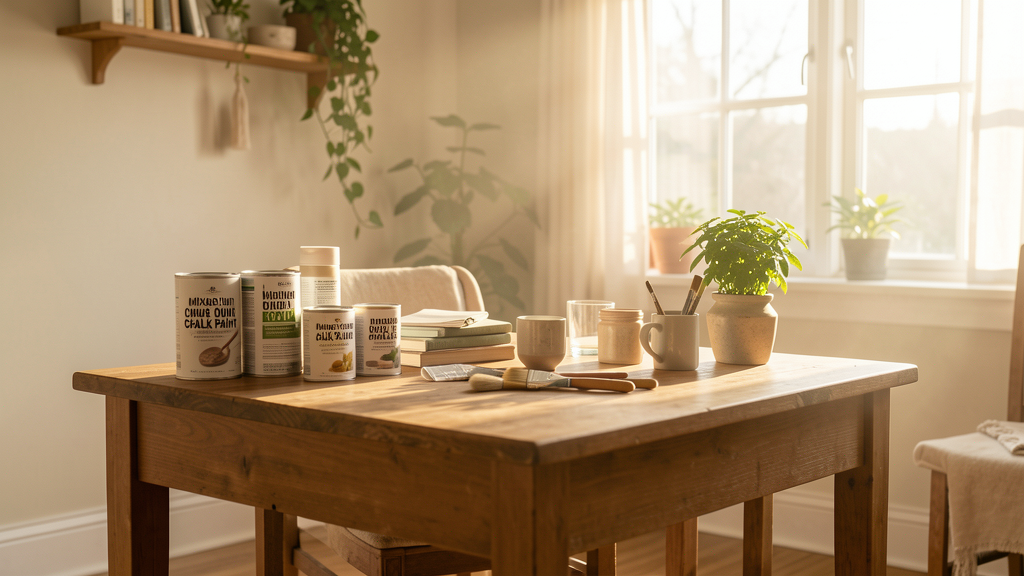
I stood in the paint aisle of my local hardware store last Tuesday, staring at a quart of "Vintage Duck Egg" decorative paint priced at $44.00. For 30 ounces of liquid. Next to it sat a gallon of high-quality interior latex eggshell in a similar teal tone for $38.00. The math is insulting, yet the cult following of brand name chalk paint keeps us coming back for that matte, velvety finish that adheres to everything without priming.
But here is the hard truth I have accepted after years of upcycling furniture for high-end looks on a shoestring budget: that proprietary texture is not magic. It is chemistry. And you can replicate it in your kitchen for a fraction of the price. The specific comparison we are looking at today is the classic DIY recipe of Plaster of Paris mixed with flat latex paint against the heavy hitters of the decorative paint world.
We are going to look past the marketing and strictly analyze the financial data and the tactile finish of both options to see if the premium is actually justified.
The "Designer" Paint Sticker Shock
Before we get into the DIY mix, we have to establish the baseline for what the market currently charges. In 2026, the pricing for popular chalk-style mineral paints has risen significantly. Most premier brands, whether imported or domestic, charge between $34 and $50 for a quart (32 oz). If you are lucky, you might find a sale price around $28, but that is rare.
To put that in perspective, covering a large six-drawer dresser typically requires about two coats of paint. Depending on the color and your application method, you will use nearly three-quarters of a quart. If you are undertaking a large project like filling a massive living room wall for under $20 using drop cloths, buying premade decorative paint would cost you a fortune in coverage alone.
The price point is the single biggest barrier to entry for this aesthetic. You are paying for the brand, the marketing, and the "no-priming" promise. However, if you are willing to spend ten minutes mixing your own batch, the cost structure flips entirely.
Breaking Down the 2026 Material Costs
I conducted a price check this morning at three major standard hardware retailers to get a realistic average for the DIY method. To make your own chalk-style paint, you need two ingredients: flat latex paint (or leftover wall paint) and Plaster of Paris. Some recipes call for water, but I prefer a thicker paste that stores better.
Here is the receipt breakdown for a custom gallon equivalent:
1. The Base Paint You do not need the most expensive paint on the shelf, but do not buy the absolute cheapest "contractor grade" either, as the pigments are weak. A mid-range flat latex paint, often found in the "OOPS" section or as a mistint, averages $22.00 per gallon in 2026. If you are buying a specific quart mixed to order, you are looking at about $12.00.
2. The Plaster of Paris A standard 4.4 lb box of Plaster of Paris runs approximately $6.50 at any hardware store. This is the key ingredient. It is a gypsum powder that, when mixed with the latex, creates the porosity and the "tooth" that allows for easy distressing and wax adhesion.
3. The Ratio Math The most reliable ratio for a high-end finish that mimics the thickness of the boutique brands is roughly 3 parts paint to 1 part Plaster of Paris by volume. For a gallon (128 oz), you would use about 96 oz of paint and roughly 32 oz of Plaster of Paris mixture.
You will not use the whole box of plaster for one gallon. In fact, that $6.50 box of Plaster of Paris will make about 3 to 4 gallons of chalk paint.
The Final Tally If we amortize the cost of the Plaster of Paris, your cost to produce one gallon of high-quality chalk paint is roughly $24.00. Compare that to the average cost of a premade decorative brand, which would be roughly $140.00 for the same volume (assuming $35/quart). You are saving nearly $116 per gallon. Even if you factor in buying a new quart of latex paint at full price ($12.00) plus a fraction of the plaster, a quart of DIY mix costs you about $13.50. The savings are undeniable.
The Texture Test: Can You Tell the Difference?
Cost is irrelevant if the result looks cheap. I have tested both methods extensively, and the finish is where we see the most significant—but manageable—differences.
The boutique brands pride themselves on a smooth, almost creamy consistency that hides brush strokes. They contain proprietary binders and resins that keep the paint suspended perfectly. When you apply a brand like this, it levels out slightly and dries to a very uniform, flat velvet finish.
The Plaster of Paris mixture behaves differently. Because you are adding a powder, the mixture thickens up significantly within 30 minutes of mixing. It does not level out as much as the premade stuff. You will see brush strokes.
However, this is not necessarily a drawback. The slight texture adds to the artisanal, "hand-painted" aesthetic that is currently trending in European-style decor. I actually prefer the DIY mix for rustic pieces because the texture catches the wax differently. When you sand back the edges to distress, the Plaster of Paris mixture powders off beautifully, revealing the wood underneath with a chalky residue that is identical to the brand name version.
The only caveat here is grit. If you do not mix the Plaster of Paris with a small amount of water to create a lump-free slurry before adding it to your paint, you will end up with granular bumps in your finish. For a modern, sleek high-end look, you must strain your DIY paint or mix it aggressively with a drill attachment to ensure it is silky.
Shelf Life and The "Mix as You Go" Reality
Here is the trade-off where the brand names win: convenience and shelf life.
A sealed can of premade decorative paint will last for years in your basement. You can buy a quart, use a cup, and put the rest on a shelf for three years without issue. The DIY Plaster of Paris mixture has a chemical clock. Once the plaster meets the water (inside the paint), it begins to cure.
You cannot store a mixed batch of DIY chalk paint for more than a few days, maybe a week if sealed tightly in a cool place. If you try to save it, it will turn into a solid rock of gypsum, ruining your container.
This changes how you must work. You have to adopt a "mix as you go" mindset. I generally only mix what I can use in a single painting session. If I have leftover latex paint, I store that. The Plaster of Paris stays dry until I am ready to start a project. This requires a shift in habit, but for the savings, it is a shift I am willing to make. It prevents the hoarding of half-empty cans of colors I will never use again, keeping my workspace cleaner.
Application and Topcoat Considerations
Both the DIY and the brand name paints require a topcoat for durability on high-traffic surfaces like dining tables or kitchen cabinets. Chalk paint is porous; it sucks up spills. You cannot skip the wax or polyurethane.
When applying wax, the DIY mix actually absorbs it slightly faster than the brand name, meaning you might use a touch more wax to achieve that sheen. However, because the base paint cost is so low, spending an extra $5 on a tin of wax doesn't hurt your budget.
One issue I have encountered with the Plaster of Paris mix is that it can be "thirsty" during the first coat. Because the plaster absorbs moisture from the latex, the paint can dry incredibly fast—sometimes too fast. Working in "wet edges" is crucial. If you paint a large area like a door and work too slowly, you will see lap marks where the wet paint meets the drying paint. Brand name paints have chemical retarders that keep them workable longer. To combat this with the DIY mix, I add a tablespoon of water to my cup as I work to keep the viscosity flowing.
The Verdict: When to DIY and When to Buy
So, should you dump the brand names entirely? Not necessarily. There is a place for both, but the criteria for decision making should be based on project size and color matching.
Buy the Brand Name if: You are painting a very small accent piece, like a picture frame or a tiny side table, and you absolutely need a specific, complex color that is impossible to match with standard latex. Also, buy it if you are a very slow painter and need the extended working time to prevent lap marks. The convenience is worth the premium for a 2-hour project.
Mix Your Own if: You are painting anything larger than a nightstand. If you are doing a dining set, a bookshelf, or kitchen cabinets, making your own paint is the only financially responsible choice. The savings are too massive to ignore. Additionally, if you enjoy experimenting with custom colors—like mixing a 2:1 ratio of black and white to get a "soft charcoal"—the DIY method gives you access to the entire spectrum of latex colors at the hardware store, rather than the 30 colors the boutique brand offers.
I also recommend the DIY route if you enjoy texture work. We have discussed 4 textures you can mimic with a mix of baking soda and paint before, but Plaster of Paris offers a different kind of grit that is excellent for creating a farmhouse or limestone effect that looks far more expensive than it is.
Moving Beyond the Label
Ultimately, the "high-end aesthetic" comes from your technique, not the label on the can. Sanding your piece properly between coats, applying a dark wax to the crevices to create depth, and using high-quality hardware are what make a piece look like it belongs in a magazine. The paint is just the medium.
By taking control of the mixing process, you stop paying for the brand's marketing budget and start paying for the materials that actually build the look. Once you get over the fear of mixing powder into paint—and realize that $116 in savings can buy you a really good set of brushes or a new sander—the brand name cans start to look a lot less attractive.
Read next

4 Textures You Can Mimic with a Mix of Baking Soda and Paint
Turn cheap, glossy vases into high-end ceramics by mixing pantry staples with acrylic paint for four distinct professional textures.
By Camila Souza · 7 min read
Why Does My DIY Spray Paint Feel Sticky and How to Fix It?
Discover why humidity traps solvents in your spray paint and exactly how to seal a tacky finish with a hardware store clear coat for a professional result.
By Camila Souza · 6 min read