
The Concept of Verticality: Using Temporary Molding to Raise Ceilings
Transform your cramped rental by using lightweight, adhesive-mounted trim to draw the eye upward and fake architectural height.


There is a specific kind of claustrophobia that sets in around 7:30 PM on a Tuesday in a standard rental box. The walls feel like they are pressing inward, the 8-foot ceilings seem to have lowered by an inch, and the entire space lacks the airiness we equate with "home." We often try to solve this by adding more lamps or decluttering, but the actual issue is usually a lack of architectural definition. The space is a plain white container, and your eye has nowhere to rest but on the limitations of the room.
To fix this, you do not need to knock down walls or hire a contractor to install drywall extensions. You need to hack the viewer's perception using a principle I call "forced verticality." By installing temporary picture rail or molding high up on the wall, you create a vertical line that compels the eye to travel upward, effectively resetting the perceived ceiling height. This isn't just decoration; it is optical geometry.
The Psychology of the Vertical Line
The human eye naturally follows lines and contrasts. In most apartments, particularly those built after the 1980s, the transition from wall to ceiling is blunt and indistinct. There is no cornice, no molding, just a 90-degree angle where the white paint of the wall meets the white paint of the ceiling. This visual ambiguity makes the ceiling feel lower because it feels like a heavy lid pressing down.
Introducing a horizontal line—like a picture rail—near the ceiling interrupts that visual stagnation. It creates a distinct "stop" point for the wall and a starting point for the upper volume. When you place trim approximately 3 to 4 inches below the actual ceiling line, you create a "soffit" effect. The space above the trim visually reads as an extension of the ceiling rather than the wall. Even though the physical height hasn't changed, the room feels taller because you have segmented the vertical plane.
Choosing Materials That Won't Destroy Your Deposit
The hardware store aisle can be overwhelming, but for this specific hack, you want to ignore the solid oak or pine crown molding. It is too heavy, too expensive, and requires brad nailers that will leave holes your landlord will charge you to patch. Instead, walk two aisles over to the polyurethane or polystyrene molding sections. Look for "lightweight picture rail" or "dental crown" profiles. These pieces are essentially dense foam.
My go-to profile for a high-end look on a budget is a simple 2.5-inch ogee picture rail. It costs roughly $12 for an 8-foot strip at most standard hardware stores. Because it is foam, it cuts effortlessly with a hacksaw blade or even a sharp utility knife, meaning you don't need a miter saw. The key to making this foam look like expensive plaster is the paint job. You must use a high-satin or semi-gloss paint; flat paint will reveal the texture of the foam and look cheap.

The Adhesive Strategy: High and Tight
Since we cannot drill into the concrete or studs of a rental, we rely entirely on adhesion. This is where most people fail. They grab a generic glue stick and watch their molding slide down the wall overnight. You need a construction adhesive designed for temporary applications.
I have a strict protocol for surface prep. Wipe the area with a damp cloth, let it dry, then wipe it down with rubbing alcohol to remove any grease or dust. Apply your adhesive—preferably a heavy-duty removable tape like the 3M Command strips or a specific removable construction adhesive—in a zigzag pattern on the back of the molding.
Press the molding firmly against the wall. Use painter's tape to hold it in place while the adhesive cures. Here is the critical trade-off: you must be incredibly precise with your leveling. Because the molding sits high up near the ceiling, even a slight 1-degree slope will be glaringly obvious. Invest in a laser level; it saves you the heartbreak of crooked trim.
If you are nervous about the adhesive holding the weight, you might want to cross-reference my list of 6 Adhesive Products That Guarantee You Get Your Security Deposit Back to ensure you are using the least invasive, strongest bond available.
Creating the Shadow Gap
The secret to the "high-end" aesthetic is not the molding itself, but the shadow it casts. When installing the rail, do not butt it flush against the ceiling. Leave a deliberate 2-inch gap between the top of the molding and the ceiling.
This gap does two things. First, it creates a shadow line that adds depth to the wall, making the room feel larger and more complex. Second, it hides any inconsistencies in the wall-to-ceiling line, which is rarely perfectly straight in older buildings. To hide this gap visually, you can paint the wall color up onto the ceiling strip, or better yet, paint the wall and the "reveal" (the gap) the same color as the trim. This blurs the line where the wall ends and the ceiling begins.
Styling the New Vertical Space
Once the molding is up, you have new opportunities for styling. If you installed a picture rail with a ledge or a hook-compatible profile, you can hang art without putting nails in the wall. Use thin brass wires to suspend framed art, varying the heights to draw the eye up and down.
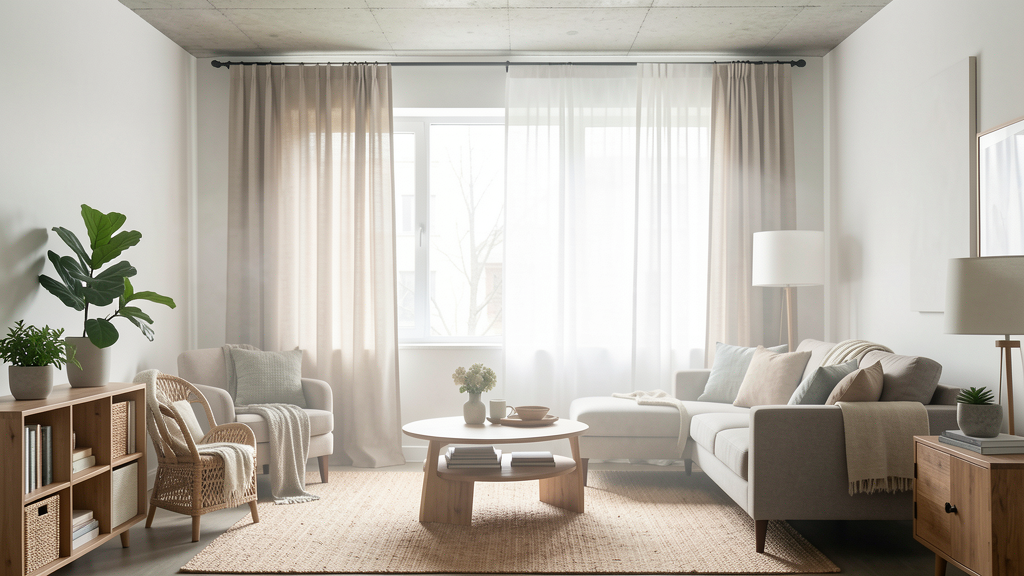
However, even if you never hang a single picture, the molding serves its purpose. It breaks the "box" feeling. If you want to amplify this effect, consider pairing the molding with Installing Ceiling-Mounted Curtains Without Drilling Into Concrete. The combination of high trim and floor-to-ceiling drapery creates a continuous vertical line that makes the room feel like a grand library rather than a rental unit.
The Reality of Rental Architecture
We have to accept that rental living often means dealing with cheap finishes and weird proportions. You cannot change the blueprint, but you can change the way light moves around the room. By adding this single horizontal element high up, you introduce a layer of sophistication that tricks the brain into thinking the structure is more substantial than it actually is.
It takes a weekend to install and costs less than a dinner out. The result is a room that breathes better, looks more expensive, and feels distinctly yours. That is the power of understanding verticality; it turns a ceiling into a volume rather than just a limit.
Read next

6 Adhesive Products That Guarantee You Get Your Security Deposit Back
A technical breakdown of six removable adhesives tested for residue-free removal on drywall, plaster, and tile to ensure you leave your rental pristine.
By Camila Souza · 6 min read
The Floating Canopy: Hanging Curtains from Concrete Without a Single Drill Bit
Create a dreamy floor-to-ceiling canopy effect on unforgiving concrete ceilings using only tension rods and industrial-strength adhesive systems.
By Camila Souza · 8 min read