
The $30 Fix: Turning a Junk Drawer into Boutique Storage
A case study on transforming a cluttered kitchen catch-all into a cohesive display using uniform acrylic dividers that mimic high-end retail.


It was a Tuesday evening in early May 2026 when my project manager, Sarah, stopped by for a quick glass of wine before dinner. We were catching up on the new season of a show we both binge, and she offered to help me grab the corkscrew from the kitchen island. I didn't think twice about saying yes. That is, until I heard the drawer jam. It was the "catch-all" drawer to the left of the sink—the one I aggressively slam shut whenever guests come over.
She tugged. It rattled. When it finally gave way, a rogue AAA battery rolled across the floor, stopping ominously by her heel. She didn't say anything judgmental, but the flush of heat that rose up my neck was enough. I knew I had to treat this space not as a dumping ground, but as part of the home's architecture. The issue wasn't that I had too much stuff; it was that the storage method failed to respect the aesthetic of the rest of the apartment.
The Inventory of Shame
I emptied the drawer onto the marble countertop the next morning. The spread was tragic in its ambiguity. I counted three different charging cables (two for devices I no longer owned), a single takeout menu from a place that closed in 2024, a tape measure, four mismatched binder clips, a loose thumbtack, and a collection of hair ties that had migrated from the bathroom. There was no logic here, only entropy.
Most people buy a "drawer organizer set" to solve this. You know the ones: the bamboo expandable trays or the pre-formed plastic molds with compartments sized for specific items you don't actually own. I tried that route last year. I bought a $45 bamboo unit. The problem was that my life didn't fit the bamboo grid. The slots were too small for my keys but too wide for the pens, so the pens just rattled around in a wooden cage. It looked tidy from a distance, but opening it felt like opening a toolbox—utilitarian, but certainly not stylish.
I wanted this drawer to feel like a jewelry box. I wanted the experience of opening it to be tactile and pleasing, not a hunt for a lighter.
Why Uniformity Creates Luxury
The pivot to acrylic wasn't random. If you walk into a high-end boutique like Aesop or COS, you notice their storage immediately. They rarely use wood or opaque materials for small items; they use clear acrylic. It disappears. It allows the product—even if the product is just a stapler and some spare change—to float. The transparency reduces visual weight.
The mistake most people make with stylish-organization is buying three different types of containers to fit the drawer. A bamboo tray here, a ceramic bowl there, a plastic bin for the pens. This creates visual noise. Your eye jumps from material to material. The "boutique" aesthetic relies on monolithic uniformity.
I decided to strip the drawer of its bamboo insert and replace it with a single material: clear, 1-inch thick acrylic. I needed a specific look: modular bins that I could arrange like Tetris pieces, rather than a fixed tray. This allowed me to customize the footprint to the weird dimensions of my kitchen drawer (which is 18 inches wide but has a notch in the back for the plumbing).
I found a set of six modular acrylic dividers online. They were knock-offs of a designer brand that charges $80 per bin. These were $24 for the set. They had polished edges and a decent weight to them—crucial. If the plastic feels thin or flimsy, it looks cheap, which defeats the purpose. If it feels heavy and glass-like, it reads as expensive.
The Invisible Grid Method
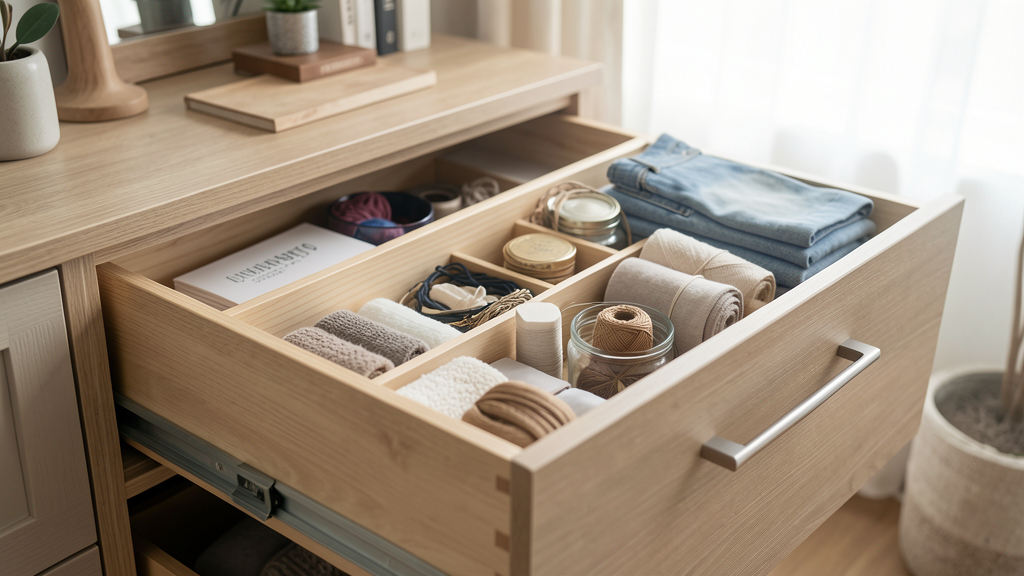
I laid the empty acrylic bins into the drawer first, playing with the configuration. I left a 2-inch gap on the left side—the "buffer zone." This is a technique I use in open shelving to prevent a cramped feeling. By leaving a small amount of negative space, the contents look intentional rather than shoved in.
Then came the editing phase. I tossed the obsolete cables and the takeout menu immediately. That was the easy part. The hard part was categorizing the leftovers. I didn't want to group things purely by function (e.g., "office stuff" vs. "hardware"). I wanted to group them by texture and visual weight.
In one long, narrow bin, I placed the batteries. They are uniform, graphic objects. They look satisfying lined up. In a square bin, I put the washi tape and the lighter—items that are colorful and chaotic. Containing them in clear acrylic frames them like art. This is similar to the logic behind The Grid System: How to Align Pantry Labels for a Custom Look; alignment creates order where none exists.
I used the larger bins for the "ugly" necessities: the spare keys and the tape measure. Because the bin walls are high (about 2.5 inches), you can't see the cluttered tops of the keys. You just see a clear box containing keys. It obscures the imperfection of the objects while keeping them accessible.
The Trade-off of Transparency
Acrylic is not a miracle material. There is a significant maintenance trade-off that you have to be willing to accept. Unlike wood, which hides dust and crumbs in its grain, acrylic highlights every speck of debris. If you drop a crumb in there, it looks like a diamond sitting on a glass counter.
I find myself wiping this drawer down with a microfiber cloth twice a week. It takes thirty seconds, but it is a habit that must be formed. Furthermore, acrylic scratches. I have two cats, and if they dig around in there (which they shouldn't, but they do), the bottom of the bins will get scuffed over time.
However, I view this as a feature rather than a bug. The visibility forces me to be tidy. I cannot let the "junk" accumulate because the container exposes it immediately. It is a self-regulating system. If the drawer looks messy, it is because I am lazy, not because the system failed. It holds me accountable.
Styling the Mundane
Once the logistics were sorted, I focused on the "styling" aspect. This might sound ridiculous for a junk drawer, but the difference between "organized" and "curated" is in the finishing touches.
I didn't just throw the pens in a bin. I selected three black ink pens that looked identical and placed them parallel to each other. I removed the paper labels from the hand soap refill bottles I kept in the back (the travel sized ones) so they were just clear cylinders of liquid. I wrapped the charging cables in velcro ties and laid them flat, creating smooth lines rather than tangled balls.
This attention to detail transforms the drawer. When Sarah came over again last weekend, I opened the same drawer to grab a coaster. She didn't notice the organization immediately; she just noticed that it was pleasant to look at. "It feels like a fancy shop in here," she said.
That is the goal. It is not about perfection; it is about elevation. By spending $24 on uniform bins and twenty minutes on alignment, I removed the embarrassment from the equation. The drawer is no longer a secret I hide; it is a detail I am happy to display.
Maintaining the Illusion
The key to keeping this looking like a Why Does Arranging Books by Color Often Look So Tacky? situation—i.e., avoiding a look that is trying too hard—is restraint. Do not overfill the bins. If a bin is full, you must edit an item out before adding a new one. The "boutique" look relies on negative space. If you cram the acrylic boxes to the brim, they look cluttered, and the transparency works against you, turning the drawer into a block of solid noise.
I have a rule now: if it doesn't have a designated "home" within the acrylic grid, it doesn't live in this drawer. The miscellaneous receipts go straight to the trash. The random screws go in the toolbox in the hall closet. This drawer is for the daily essentials only.
Ultimately, this project wasn't just about cleaning. It was about changing the relationship I have with the small, ignored parts of my home. We spend so much time styling the visible surfaces—the sofa, the coffee table, the shelves. But the interior of a cabinet or a drawer is where you live. Opening a drawer that functions beautifully and looks pristine brings a small, jolt of joy to an otherwise mundane task. It turns the search for a pair of scissors into a moment of appreciation for your own discipline.
Read next

The Grid System: How to Align Pantry Labels for a Custom Look
Eliminate the visual noise of crooked pantry labels by using a physical tape grid system that guarantees professional alignment on any budget.
By Beatriz Costa · 7 min read

Why Does Arranging Books by Color Often Look So Tacky?
Moving beyond the rainbow trend requires understanding why spectral organization often creates visual noise rather than harmony in a lived-in home.
By Beatriz Costa · 6 min read